 English


Technology and design
Design priorities: usability, safety and effectiveness
The DAVID Generation Line combines joint-specific biomechanics, isolated movement, variable resistance curves and automatic weight selection (AWS) with a Nordic design. Generation Line medical devices (except G250) are Class Im medical devices, CE 0598, under Directive 93/42/EEC.
Safety in design
Beyond the requirements for CE marking, DAVID designs its devices to support controlled exercise: joint alignment, fixations and resistance curves are chosen to load the target muscles while limiting unwanted strain on joints. As with any exercise, temporary muscle soreness may occur. See the instructions for use for contraindications and precautions.
Effectiveness
Effectiveness is a core objective in our equipment design. Within safety limits, each exercise is designed to load the target muscles effectively. DAVID has taken part in and initiated research in biomechanics and exercise since the 1980s; references are listed on our Scientific evidence page.
User-friendly experience
Our third objective is a positive user experience. After assessment, set-up and instruction by a trained professional, suitable patients can train on DAVID devices with the level of supervision set by the treating professional.
Experience the Difference
DAVID devices combine usability, safety features and effective loading. We continue to develop our devices and software together with users and researchers.
Design principles explained
Biomechanical precision
Biomechanical engineering supports control and effectiveness of the exercise. Within the intended purpose of each device, settings can be adapted from early-stage rehabilitation to high-intensity training. DAVID’s exercise specialists develop all equipment for the spine, shoulder, hip and knee on the basis of these elements:
Correct posture – the device positions the body at the angles needed to load the target muscle group (agonist).
Isolation – the antagonist and compensating muscles are limited as far as possible to focus the training stimulus.
Resistance curves – the DAVID resistance curve takes account of the strength–length relationship, the stretch-shortening cycle and fatigue.
Controlled loading – the resistance curve is designed to limit unwanted strain on the joints.
Individual settings – on equipped models, saved settings are adjusted automatically for each user.
Isolated vs. functional training
Why can isolated training on DAVID devices be useful alongside functional training? People with musculoskeletal complaints often compensate by using other muscle groups to perform a movement. Rehabilitation can aim to reduce this compensation.
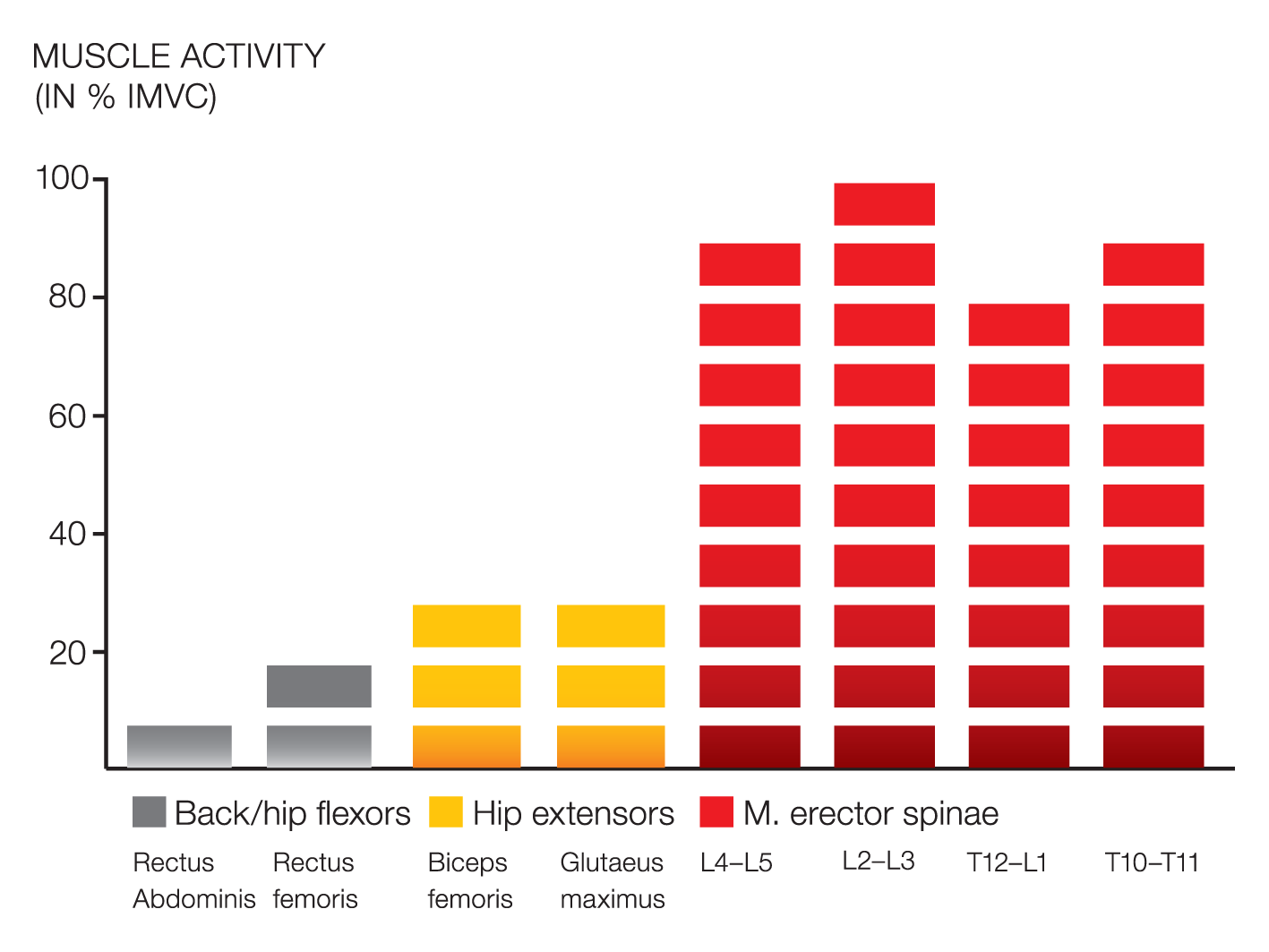
DAVID devices use isolation to activate the target muscle groups. An example is the hip fixation on the G110 Lumbar/Thoracic Extension, which limits the activity of the hip extensors (Denner 1997, see below).
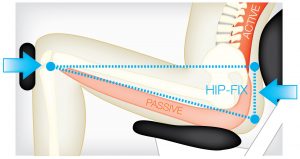
DAVID’s isolation principle
EMG validation studies were conducted in collaboration with the University of Cologne, Germany, to determine if DAVID’s isolation principle activated the target muscles (agonist) and blocked the surrounding solid muscles (antogonist). This example of the Back Extension Device results showed that the strong hip extensors were blocked and inhibited, creating a high activation level in the spinal target muscles.
Resistance curves and training safety
Unsuitable resistance curves can lead to discomfort and overload. With some leg extension designs, resistance is low at the start of the movement, which can tempt users to use momentum; this may overload the knee in the extended position, particularly in the eccentric phase. Elastic bands used for glenohumeral internal and external rotation increase resistance as they stretch, while muscle strength decreases towards the end of the movement, which can place additional strain on the joint.
Resistance curves should match the muscle’s capacity at each stage of the movement and take account of the stretch-shortening cycle and disproportionate fatigue (see “Effectiveness”). Suitable resistance curves help to load the muscles effectively while reducing the risk of injury and discomfort.
Supporting safe training
Poorly designed biomechanics in exercise machines can lead users to overload certain body parts or perform exercises incorrectly. DAVID devices are designed with joint alignment, fixations and resistance curves that support correct exercise execution under professional guidance.
Joint alignment
While joint alignment may seem straightforward, it is complex. A common design mistake is to align the joint visually based on its static position, overlooking dynamic factors. During movement, the centre of rotation of a joint can differ significantly from its static position.
Take horizontal shoulder abduction and adduction (pec deck) as an example. Many devices place the axes at shoulder width, but DAVID’s analysis places them approximately 10 cm closer together. During this exercise the shoulder joints follow an arched path, and the “virtual joint” lies between the shoulder joint and the medial end of the collarbone.
DAVID analyses the “virtual joint” position for each exercise device. This joint alignment is designed to support comfortable, controlled movement for people with different joint and muscle conditions, within the intended purpose of each device.
Controlling the range of motion
Users range from healthy people to patients with joint and muscle conditions, so the range of motion must be controlled.
Two features control the range of motion:
- Range of motion adjustment (RMA): the therapist sets the start of the movement so that the movement stays within the selected range.
- Range of motion control (RMC): the EVE display shows coloured zones, with green for the range selected by the therapist. If the movement goes beyond this range, a red signal alerts the user.
With EVE, users train within the range of motion set by the therapist and practise movement control. The RMA setting limits the movement range mechanically.
These features help users exercise within their capabilities and support the treating professional in managing patients with specific joint and muscle conditions.
The role of gravity (inertia) in training
Scientific evidence highlights the crucial role of gravity-induced resistance in fully engaging muscle cells and achieving optimized training outcomes. Throughout the course of human evolution, our muscles and nervous system have evolved to adapt to inertial loads, making them an essential component of effective training.
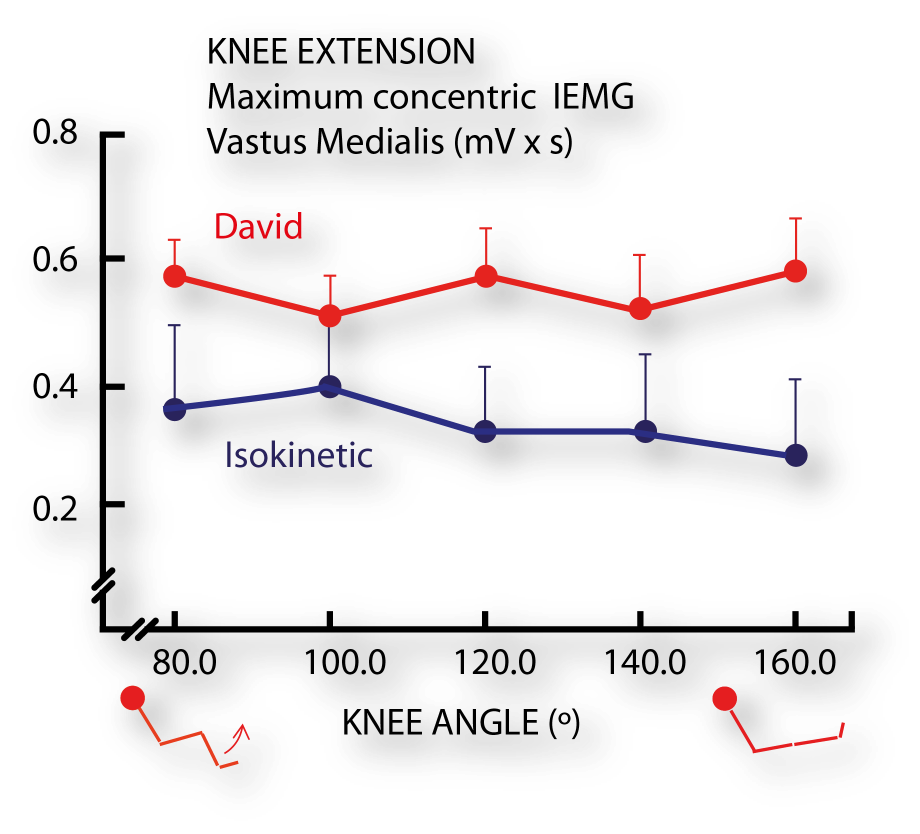
In a study of knee extensor training, concentric contractions against variable gravity-based resistance produced marked fatigue effects on neuromuscular performance (Häkkinen K, Kauhanen H, Komi PV. Electromyogr Clin Neurophysiol 1988;28(2-3):79-87).
Usability
We aim to design devices that users can operate confidently after instruction. This is challenging, because precise adjustments for different body types and firm fixations for isolation and movement control are needed for safe and effective exercise. With many rehabilitation devices, physiotherapists must make several adjustments and secure patients into the device manually.
On electronic models, actuators make the main adjustments using position settings retrieved from the cloud. Minor adjustments use gas springs or sliding cushions. Lockable gas springs secure the body fixations for isolation of the target joint. All parts that users interact with are marked in yellow. After assessment and instruction, suitable patients can operate the devices with the level of supervision set by the treating professional.
Exercise therapy involves many variables, such as load, start and end positions, movement speed, duration, number of sets and range progression. Without digital support these must be set and monitored manually, which can lead to errors.
DAVID terminals provide visual guidance to help patients follow the programme set by their therapist. The cloud software stores individual settings and training data, so the selected training variables can be applied at each session. Recorded data gives the treating professional insight into training compliance and helps to apply the intended training dose.
Effectiveness
Effectiveness in design
At DAVID, our primary goal in equipment design has always been to make exercises as practical and effective as possible within safety limitations. To achieve this, we have dedicated ourselves to extensive research for over a quarter of a century, both participating in and initiating studies in various areas. Our knowledge is built upon decades of biomechanical and physiological research, dating back to the 1980s, and continues with ongoing studies in Finland, Germany, and Austria.
We don’t settle for mere assumptions about having the right technology or concept; instead, we believe in proving the efficacy of our solutions. Our commitment to research may be a long road, but the rewards are worth it. A remarkable example of this is the NICE guidelines in the UK, where our work made a significant impact. It took 17 years from the publication of a study involving DAVID back devices before it was incorporated into the guidelines for treating chronic and recurrent back pain.
We continue to develop our devices and concepts based on scientific evidence and user experience.
The Importance of Specific Training
It is often said that guided exercises on devices are less useful than free-weight exercises that train coordination. However, training effects are largely specific to the movement trained. A bench press, for example, mainly trains the muscles and nervous system to perform that specific movement.
It is worth asking whether an exercise is an effective and safe way to train the target muscles and joints. Exercises that demand high coordination usually allow lower training intensity, while high-intensity free-weight exercises such as squats require good technique to limit the risk of back injury.
Therefore, it is vital to determine the primary motivation behind each exercise. Is it to become skillful in a specific movement, like bench press, or is it to strengthen the muscles and joints to function effectively in daily life or participate in sports safely? Understanding the purpose of each exercise helps us tailor training regimens that align with specific goals to prioritize overall strength, functionality, and safety.
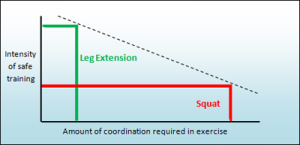
DAVID focuses on the latter: controlled, effective and comfortable exercises for the main muscle groups and joints of the body.
The Loading Principle in Exercise Equipment Design
When it comes to designing exercise machines, there is an important difference between multi-joint and single-joint exercises. In multi-joint exercises such as the leg press, the load on the muscles changes naturally as the leverage of the skeleton changes. Single-joint movements such as the knee extension need precise load regulation, often with an eccentric cam. A multi-joint device can therefore work well without load regulation, provided it moves smoothly and has suitable seats, grips and foot plates.
For single-joint movements, load regulation matters. CE marking covers technical safety; biomechanical design determines how the load is distributed over the range of motion.
DAVID designs the loading of both multi-joint and single-joint devices with attention to technical and biomechanical safety, to support effective exercise while limiting the risk of injury.
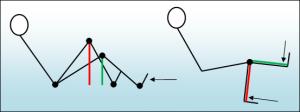
In a multi-joint movement the load is regulated by the changing “leverage arm” of the musculoskeletal system. In the beginning (red) the leverage is long, as legs are straightened (green) the leverage shortens and the load to muscles is reduced. In a single joint movement, the leverage arm remains the same in all positions and therefore the load must be regulated by the device.
Strength–length relationship of the sarcomere
The first basis for the loading design is how the smallest unit of the muscle, the sarcomere, works. The sarcomere consists of two filaments, myosin and actin, which slide past each other and are connected by cross-bridges.
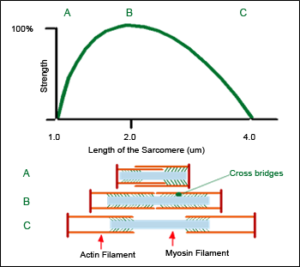
The number of active cross-bridges determines the pulling force of the sarcomere. Most interactions occur around the middle of the sarcomere’s length. When it is lengthened, many cross-bridges detach; when it is shortened, the filaments overlap.
In short, purely concentric pulling force of the muscle is the greatest at the midpoint of the movement.
Stretch-shortening cycle
The graph shows the importance of the eccentric–concentric cycle. In the eccentric phase, muscles are active while lengthening; in the concentric phase, while shortening. In the study shown, concentric force was higher when preceded by an eccentric phase (middle graph) than in a purely concentric contraction (left). The effect was lost when the pause after the eccentric phase lasted 0.9 seconds or more (right) (Häkkinen, Komi, Kauhanen 1986).
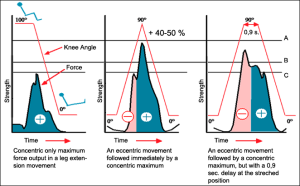
Häkkinen K, Komi PV, Kauhanen H. Electromyographic and force production characteristics of leg extensor muscles of elite weight lifters during isometric, concentric, and various stretch-shortening cycle exercises. Int J Sports Med 1986;7(3):144-151.
This phenomenon is a critical characteristic of the muscles in real world situations where we have to face mass with inertia. Without even understanding this theory, we practice this in every-day situations. For example if we need to jump up, we go down first in a rapid movement before changing direction. This would seem unusual, since we have to first decelerate our body mass on the way down and again accelerate on the way up.
Pneumatic or motor-driven resistance behaves differently from inertial load, especially at different movement speeds, and the stretch-shortening cycle is an important part of muscle function. DAVID devices combine the cam principle with weight-stack (inertial) loading to provide variable resistance at different training speeds.
Disproportionate muscle fatigue
Muscle fatigue causes the reduction of strength with each passing repetition. This is a very well known fact and can be felt by every exerciser.
What is not so well known is that the muscle does not fatigue in a proportional manner at all muscle lengths. In fact the muscle fatigues in a disproportional manner in shortened position.
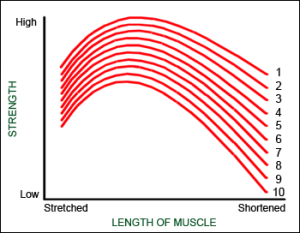
The graph demonstrates that the “strength curve” produced by the muscle changes as the fatigue progresses.
This is easiest to understand with a single maximal repetition. Because the load is very high, the movement is slow, and the muscle fatigues during the repetition, so it is more fatigued at the end of the movement than at the beginning. The same happens over a set of repetitions.
Nordic design: simplicity, minimalism and functionality
DAVID devices follow Nordic design principles of simplicity and functionality.
The end-user experience is the ultimate driving force for us at DAVID when we design new products. Naturally we have to think about costs, maintenance and other client (facility owner) related matters, but they should never supersede the end user needs.
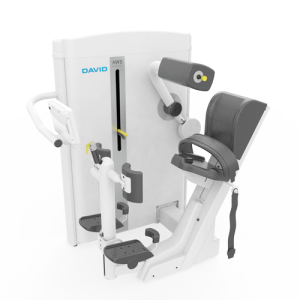
Automatic Weight Selection (AWS)
In November 2022, DAVID introduced Automatic Weight Selection (AWS). AWS sets the load saved in the patient’s EVE programme automatically and operates quietly, so weight pins no longer need to be inserted by hand.
On equipped models, AWS adjusts the weight, seat height and range of motion to the patient’s saved settings. After assessment, set-up and instruction, suitable patients can train with the level of supervision set by the treating professional, who reviews programme and execution.
Our innovative technology ensures that training remains patient-focused, hassle-free, and noiseless, providing an unmatched training experience for users. At DAVID, we strive to redefine exercise equipment standards, delivering solutions that prioritize convenience, precision, and effectiveness. Experience the world’s most silent devices with DAVID Exercise Equipment today.
References
- Denner A. Muskuläre Profile der Wirbelsäule. Berlin, Heidelberg: Springer; 1997. Chapter 7.4, Ergebnisse eigener Reliabilitäts- und Validitätsuntersuchungen; p. 163–178.
- Häkkinen K, Komi PV, Kauhanen H. Scientific Evaluation of Specific Loading of the Knee Extensors with Variable Resistance, ‘Isokinetic’ and Barbell Exercises. Med Sport Sci. 1987;26:224-237.
- Häkkinen K, Kauhanen H, Komi PV. Effects of fatiguing loading with a variable resistance equipment on neural activation and force production of the knee extensor muscles. Electromyogr Clin Neurophysiol. 1988;28(2-3):79-87.
- Häkkinen K, Komi PV, Kauhanen H. Electromyographic and force production characteristics of leg extensor muscles of elite weight lifters during isometric, concentric, and various stretch-shortening cycle exercises. Int J Sports Med 1986;7(3):144-151.
Generation Line medical devices (except G250): Class Im, CE 0598, MDD 93/42/EEC. The G250 Elliptic Leg Press is a training device and not a medical device. Use DAVID medical devices only as described in the instructions for use. See the instructions for use for intended purpose, contraindications and precautions. Exercise may cause temporary muscle soreness.
Transforming musculoskeletal care
Download our Ebook