English


The gym-floor legacy
Much of the equipment now standing in rehabilitation and medical fitness rooms was, at its core, developed for the fitness industry and later relabelled “medical.” Multi-function strength stations, pneumatic machines, and smart circuit-training systems are good examples. They’re robust, look fresh, and fit the feel of a modern gym. For general conditioning, muscle maintenance in older adults, or a low-threshold first introduction to training, they work perfectly well.
The problem starts as soon as the need becomes more specific. A patient with chronic low back pain, a post-operative shoulder, or whiplash symptoms doesn’t need a general strength exercise that “should probably be fine” for the spine. That patient needs isolated, controlled movement, at exactly the right load, within a safe range of motion, and with objective measurement data that shows whether the treatment is actually working. Generic equipment, however modern, is rarely built for that. Fixation is often insufficient to rule out compensatory movement, and the software — where it exists at all — is built to count reps and calories, not track clinical progress.
Speed versus specificity
The smart circuit concepts that have become popular in recent years also deserve a fair look. They promise efficiency: a full training round in half an hour, automatically configured from a profile. For member retention in a fitness club, that’s a strong business model. But efficiency isn’t the same as clinical depth. A circuit that moves everyone through the same sequence of movements isn’t built to tell the difference between a discopathy and a facet joint problem, and rarely gives therapists the fine-grained control an individual rehabilitation pathway requires.
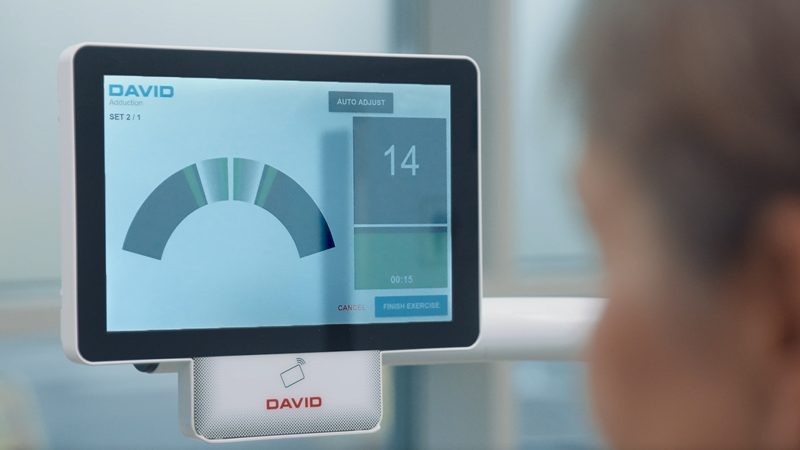
That’s exactly where we at DAVID have been trying to make a difference for over forty years. Our equipment isolates joint-specific movement — from the spine to the shoulder, hip, and knee — with fixation validated through EMG research: target muscles are activated while others are kept at rest. Every session produces objective measurement data on strength and mobility, benchmarked against reference values, so the therapist doesn’t have to guess but can adjust based on facts. Our EVE platform automatically translates that data into a tailored, progressive protocol, including pain monitoring — software-driven care instead of a fixed training schedule that’s the same for everyone.
Why this matters for running a practice
This isn’t a technical detail for enthusiasts. It goes to the heart of what every practice owner is grappling with right now: being able to demonstrate that a treatment works, helping more people in less time per patient, while still meeting insurers’ documentation requirements.
Research into integrated care pathways combining joint-specific training with data-driven progression shows savings of more than €1,500 per patient per year compared with standard care — not because the equipment looks better, but because the treatment fits precisely what the patient needs, with less relapse and faster throughput.
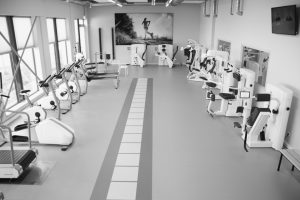
Then there’s the space factor. Where generic setups quickly require 100 to 150 square metres, a full spine training pathway with our equipment fits within 25 square metres. For practices in city centres or leased premises with limited floor space, that’s a direct financial argument, not just a clinical one.
Asking a different question
The question practice owners should be asking themselves, then, isn’t “which machine looks the most professional,” but “which equipment helps me deliver demonstrably better care, with less noise and more evidence.” Equipment borrowed from the fitness industry can have a place in a practice — for general conditioning, there’s nothing wrong with it. But at the clinical heart of physiotherapy, where specificity and measurability make the difference between a patient who returns to work and one who keeps living with symptoms, generic simply isn’t enough.
We believe physiotherapy practices deserve that choice: equipment designed from the biomechanics of the joint, not from the gym floor. That’s the principle DAVID has worked from since 1981, and it’s a discussion we believe the whole sector could stand to have a little more sharply.