 English


What is cervicogenic headache?
Cervicogenic headache is a secondary headache: the pain is referred from a disorder of the cervical spine or the soft tissues of the neck. The upper cervical segments (C0–C3) are most often involved, because their sensory input converges with that of the trigeminal nerve in the brainstem. The result is pain that is felt in the head, often in the occipital, temporal or frontal region.
Estimates of prevalence vary with the criteria used. A 2022 review reports a prevalence of 1–4% among people who experience headache [2].
Typical clinical features include:
- side-locked, unilateral headache that starts in the neck and spreads forward
- headache provoked by neck movement or sustained neck postures
- reduced cervical range of motion
- tenderness of the upper cervical joints
The ICHD-3 diagnostic criteria
The International Headache Society lists cervicogenic headache as code 11.2.1 in the International Classification of Headache Disorders, 3rd edition [3]. In short, a diagnosis requires:
- Any headache fulfilling criterion 3.
- Clinical and/or imaging evidence of a disorder or lesion in the cervical spine or soft tissues of the neck that is known to be able to cause headache.
- Evidence of causation shown by at least two of the following:
- the headache developed in temporal relation to the onset of the cervical disorder;
- the headache improved or resolved in parallel with improvement of the cervical disorder;
- cervical range of motion is reduced and the headache is made worse by provocative manoeuvres;
- the headache is abolished after diagnostic blockade of a cervical structure or its nerve supply.
- Not better accounted for by another ICHD-3 diagnosis.
Criterion 4 matters in practice. Migraine and tension-type headache can both produce neck pain and neck tenderness, so neck symptoms alone do not confirm a cervical origin.
Clinical assessment: what helps
The physical examination focuses on three areas: cervical mobility, upper cervical joint signs and deep neck flexor control.
Cervical flexion-rotation test (FRT). With the neck held in full flexion, the examiner rotates the head to each side. Flexion limits movement at the lower levels, so the test mainly measures rotation at C1/2. In a study of 40 participants, experienced examiners identified headache from C1/2 dysfunction with 90% sensitivity and 88% specificity [4]. A positive test is usually defined as rotation to the limited side of about 30° or less, or a marked side-to-side difference.
A cluster of impairments. Jull and colleagues compared people with cervicogenic headache, migraine and tension-type headache. The combination of reduced cervical range of motion, painful upper cervical joint dysfunction and impaired craniocervical flexion identified cervicogenic headache with 100% sensitivity and 94% specificity [5]. The sample was small, so these figures need confirmation, but the cluster gives clinicians a structured starting point.
Craniocervical flexion test. This low-load test measures how well the deep neck flexors hold progressive stages of upper cervical flexion. People with cervicogenic headache often reach lower stages and substitute with the superficial neck muscles.
The evidence for exercise therapy
The landmark trial. The best-known randomised controlled trial randomised 200 adults with cervicogenic headache to manipulative therapy, exercise therapy, both, or a control group [6]. Treatment ran for six weeks, with follow-up to 12 months. The exercise programme was low-load: endurance training of the deep neck flexors and scapular muscles, with postural correction. Both manipulative therapy and exercise reduced headache frequency and intensity compared with control, and the effects were maintained at 12 months. The combined approach showed a small, non-significant extra benefit.
Systematic reviews. Later reviews support this picture, with caveats on study quality:
- A review of 14 randomised trials found that neck exercise reduced long-term headache intensity compared with no treatment (mean difference −1.5 on a 0–10 scale, one high-quality trial, n = 100) and compared with aerobic exercise (−1.2 on a 0–10 scale, one trial, n = 180) [7].
- A review of 20 trials with 1,439 patients concluded that manual and exercise therapy may reduce headache intensity, frequency and disability in the short and long term, but rated the risk of bias in most trials as high [2].
The consistent message is that exercise appears to help, and that its effect seems to last. The evidence base is still small, and the best type and dose of exercise is not yet known.
What this means in practice
For patients who meet the diagnostic criteria, the evidence supports an active, exercise-based programme guided by the physiotherapist. Points to consider:
- Start low, progress deliberately. The trial protocols began with low-load motor control work for the deep neck flexors before adding load. A programme of about 8–10 sessions over 6 weeks is a common starting format [2].
- Measure what you treat. Range of motion and strength of the neck muscles are part of the diagnosis, so they are also useful to follow during treatment. Objective measures help the physiotherapist decide when to progress, and they show patients how they are improving.
- Combine where useful. Manual therapy may give short-term relief, while exercise appears to add the longer-term benefit.
- Screen first. Red flags, and headache types that need medical management, should be ruled out before starting cervical loading.
Exercise may cause temporary muscle soreness, particularly in the first weeks of a new programme.
How DAVID supports cervical exercise therapy
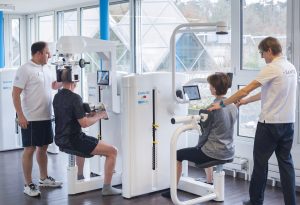
The DAVID Spine Solution includes Generation Line devices for training the neck and trunk muscles. The treating physiotherapist sets the range of motion and the resistance for each patient. Each session is recorded in EVE, so range of motion and strength can be followed over time. Suitability and contraindications are assessed by a trained professional. Read the instructions for use for contraindications and precautions.
References
- Hall TM, Briffa K, Hopper D, Robinson K. Comparative analysis and diagnostic accuracy of the cervical flexion-rotation test. J Headache Pain. 2010;11(5):391–397. doi:10.1007/s10194-010-0222-3
- Bini P, Hohenschurz-Schmidt D, Masullo V, Pitt D, Draper-Rodi J. The effectiveness of manual and exercise therapy on headache intensity and frequency among patients with cervicogenic headache: a systematic review and meta-analysis. Chiropr Man Therap. 2022;30(1):49. doi:10.1186/s12998-022-00459-9
- Headache Classification Committee of the International Headache Society. The International Classification of Headache Disorders, 3rd edition. Cephalalgia. 2018;38(1):1–211. doi:10.1177/0333102417738202
- Hall TM, Robinson KW, Fujinawa O, Akasaka K, Pyne EA. Intertester reliability and diagnostic validity of the cervical flexion-rotation test. J Manipulative Physiol Ther. 2008;31(4):293–300. doi:10.1016/j.jmpt.2008.03.012
- Jull G, Amiri M, Bullock-Saxton J, Darnell R, Lander C. Cervical musculoskeletal impairment in frequent intermittent headache. Part 1: subjects with single headaches. Cephalalgia. 2007;27(7):793–802. doi:10.1111/j.1468-2982.2007.01345.x
- Jull G, Trott P, Potter H, et al. A randomized controlled trial of exercise and manipulative therapy for cervicogenic headache. Spine. 2002;27(17):1835–1843. doi:10.1097/00007632-200209010-00004
- Demont A, Lafrance S, Gaska C, Kechichian A, Bourmaud A, Desmeules F. Efficacy of physiotherapy interventions for the management of adults with cervicogenic headache: a systematic review and meta-analyses. PM R. 2023;15(5):613–628. doi:10.1002/pmrj.12856


