English


The research community has noticed
In 2022, Hansford and colleagues published an overview in the British Journal of Sports Medicine with a pointed title: “If exercise is medicine, why don’t we know the dose?” They reviewed systematic reviews that assessed how exercise interventions are reported across many health conditions. They concluded that key details are frequently missing, including intensity, progression and adherence. Those are exactly the details you would need to repeat a programme or understand why it worked.
This is not a new concern. To make exercise programmes reproducible, researchers developed the 16-item Consensus on Exercise Reporting Template (CERT) (Slade et al., 2016). CERT asks for details such as load, progression rules and how adherence was measured. If these standards exist for trials, it is fair to ask how many of those items a typical clinic records in daily practice.
At the same time, the case for exercise itself is strong. A 2017 systematic review by Babatunde and colleagues in PLOS ONE identified therapeutic exercise as an effective first-line approach for common musculoskeletal conditions. The gap is not whether exercise helps. The gap is knowing what was actually done.
Why the dose matters in a clinic, not just in a paper
Missing dose data is a practical problem as well as an academic one. It shows up in daily practice in at least three ways:
- Progression becomes guesswork. Without a recorded baseline and session-by-session load, it is hard to decide whether a patient is ready for more. You may hold back too long or push too early.
- Evaluation becomes a conversation instead of a comparison. At the re-assessment, you have the patient’s impression and your own memory. You don’t have a curve.
- Accountability becomes harder. Referrers, insurers and your own management increasingly want to know what the treatment involved and what changed. “We did exercises” is a weak answer to that question.
There is also a continuity problem. When a patient sees two or three different therapists, undocumented dosing means each one starts from their own estimate.
What “measurable” looks like in practice
Measuring the dose does not mean more paperwork. Done well, it means less. The principle is simple: the equipment records what happens, so the therapist doesn’t have to.
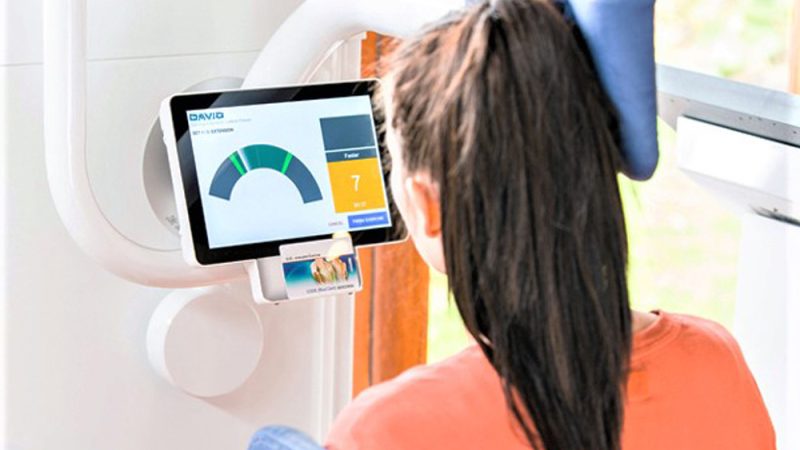
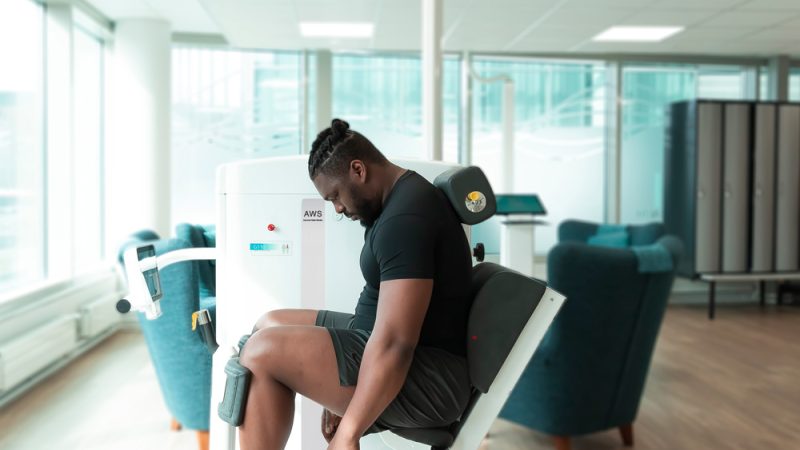
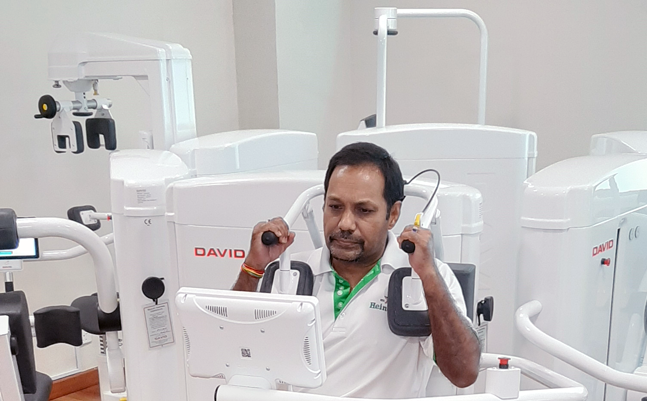
This is the approach behind DAVID’s g-line. Each device isolates a specific joint or movement segment, such as the lumbar spine, neck, hip, knee or shoulder, and records the session repetition by repetition:
- A baseline test documents strength and range of motion at the start, so the programme is built on a measured starting point.
- The protocol sets the load based on that baseline and adjusts it as the patient progresses.
- Every repetition is logged, including load, range and completed volume, without the therapist entering anything by hand.
- Re-tests show change over time, so the evaluation is based on a comparison of documented values.
The therapist remains in charge of clinical decisions. What changes is the information those decisions rest on.

Practical takeaways for your clinic
You don’t need new equipment to start closing the dose gap. A few steps help in any setting:
- Pick three variables and record them every session. For example: load, repetitions and range of motion. Consistency matters more than completeness.
- Define progression rules in advance. Decide what has to happen before load increases, and write it into the protocol rather than leaving it to the day.
- Test at baseline and at fixed intervals. A re-test at week six and week twelve gives you two data points to compare, not two impressions.
- Use CERT as a checklist. Even outside research, its 16 items are a useful audit of what your programmes leave undefined.
- Measure the time spent documenting. If your therapists are writing up sessions at the end of the day, that time is part of the cost of not measuring automatically.
From estimate to evidence
Exercise therapy is one of the best-supported treatments in musculoskeletal care. It is also one of the least precisely recorded. Clinics that close that gap can show referrers, insurers and patients what was done and what changed.
If you’d like to see how the g-line records dose and progression in a real treatment session, get in touch with the DAVID team to arrange a demo. We are happy to walk you through the data.
Sources:
- Hansford HJ, Wewege MA, Cashin AG, Hagstrom AD, Clifford BK, McAuley JH, Jones MD. If exercise is medicine, why don’t we know the dose? An overview of systematic reviews assessing reporting quality of exercise interventions in health and disease. Br J Sports Med. 2022;56(12):692-700. doi:10.1136/bjsports-2021-104977. PMID: 35168956. https://pubmed.ncbi.nlm.nih.gov/35168956/
- Slade SC, Dionne CE, Underwood M, Buchbinder R. Consensus on Exercise Reporting Template (CERT): Explanation and Elaboration Statement. Br J Sports Med. 2016;50(23):1428-1437. doi:10.1136/bjsports-2016-096651. PMID: 27707738. https://pubmed.ncbi.nlm.nih.gov/27707738/
- Babatunde OO, Jordan JL, Van der Windt DA, Hill JC, Foster NE, Protheroe J. Effective treatment options for musculoskeletal pain in primary care: A systematic overview of current evidence. PLoS One. 2017;12(6):e0178621. doi:10.1371/journal.pone.0178621. PMID: 28640822. https://pubmed.ncbi.nlm.nih.gov/28640822/