English


The core difference: training a body vs. treating a person
Traditional gym equipment is designed around load. Add weight, move it, repeat. The assumption is that the user already knows their capabilities, moves with good form, and has no underlying condition that the exercise might aggravate.
Medical-grade devices are designed around the individual. They account for the fact that the person using them may have pain, asymmetry, limited range of motion, or a specific clinical goal. Instead of simply asking “how much can you lift?”, they ask “what does this body need, and how do we deliver it safely and measurably?”
That shift, from generic loading to targeted, monitored treatment, is the foundation of everything that follows.
1. Isolation that actually isolates
One of the biggest problems with conventional equipment is compensation. When the deep stabilising muscles of the spine, hips, or neck are weak, the body is remarkably good at recruiting larger surrounding muscles to do the work instead. On a standard machine, that compensation goes unnoticed, the weight still moves, so it looks like progress.
DAVID’s g-line clinical devices are built to lock out compensation. Through carefully engineered fixation, positioning, and guided movement paths, they ensure the target musculature is the muscle being challenged. For spinal rehabilitation in particular, this matters enormously: strengthening the segmental muscles that protect the spine requires stabilising the rest of the body so those small, deep muscles can’t hide behind stronger movers.
The result is training that reaches the structures clinical recovery actually depends on, not just the muscles that are already strong.
2. Measurement turns guesswork into data
Ask someone on a typical leg-press machine how strong they are, and you’ll get a number on a weight stack. Ask them how their range of motion compares to last month, whether their left and right sides are balanced, or whether their deep extensors have improved, and there’s no answer.
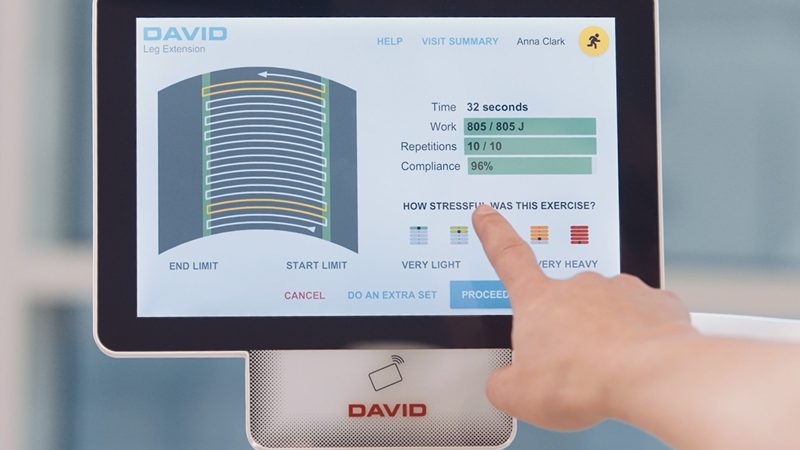
Medical-grade equipment is instrumented. It captures range of motion, force output, and progression over time, then turns that into objective feedback for both the user and the clinician. This does three things traditional gear can’t:
- It establishes a baseline. You can’t manage what you don’t measure. Objective starting points enable the setting of realistic, condition-appropriate goals.
- It guides dosage. Resistance and range can be adjusted to the individual’s tested capacity rather than a guess, keeping training in the effective and safe zone.
- It proves progress. Measurable improvement is motivating for users and meaningful for clinicians, insurers, and referring physicians who need evidence that treatment works.
When progress is visible on a screen rather than felt vaguely, people stay engaged, and engagement is one of the strongest predictors of long-term outcomes.
3. Controlled, guided motion reduces risk
Free weights and open cable systems give the body almost unlimited freedom of movement. For an experienced, healthy athlete, that freedom is a feature. For someone recovering from injury or managing chronic pain, it’s a liability, every uncontrolled degree of motion is an opportunity to aggravate the very problem you’re trying to fix.
Medical-grade devices guide movement along a defined, anatomically appropriate path. Range of motion can be limited to a safe arc, resistance curves can be matched to the targeted joint’s strength profile, and the user is supported throughout. This lets people train meaningfully earlier in recovery and at intensities that would be unsafe on conventional equipment, accelerating progress without increasing risk.
4. Built on evidence, not just tradition
Much of what happens in a standard gym is inherited from bodybuilding and sports culture: exercises and protocols passed down because they “work,” not because they were studied in a clinical population. Medical-grade systems take the opposite path. Protocols are grounded in rehabilitation science, particularly for the spine, neck, and other areas where loading must be specific, progressive, and carefully controlled.
That evidence-based means clinicians aren’t improvising. They’re applying proven approaches using equipment designed to deliver them precisely, resulting in more consistent results across patients and conditions.
5. Designed for everyone, not just the fit
There’s an intimidation barrier in most gyms. The equipment is built for people who already know how to use it, and that quietly excludes the populations who often need strength training the most: older adults, people in pain, and those returning to movement after a long absence.
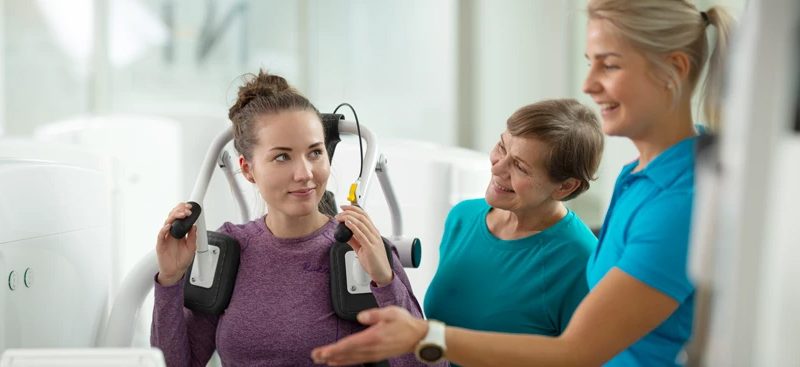
DAVID’s approach, smart, user-friendly equipment in a warm, accessible design, lowers that barrier. The G-Line brings the same engineering quality into active-ageing and wellness settings, where the priority is keeping people moving, confident, and progressing rather than pushing maximal loads. Equipment that feels approachable gets used, and equipment that gets used delivers results. Adherence is where many traditional programs quietly fail, and thoughtful design is one of the most underrated drivers of better outcomes.
What “better outcomes” really means
Better outcomes aren’t just a stronger lift. In a clinical and active-ageing context, they look like:
- Less pain and better function in daily life
- Restored strength in the specific structures that drive recovery
- Lower risk of re-injury through controlled, appropriate loading
- Objective, documented progress that motivates users and satisfies clinicians
- Higher adherence because the experience is safe, guided, and genuinely encouraging
Traditional gym equipment can build general fitness, and it has its place. But when the goal is recovery, longevity, and measurable clinical results, the gap between “moving weight” and “treating the person” is decisive.
The bottom line
Medical-grade equipment isn’t traditional gym gear with a higher price tag. It’s a fundamentally different philosophy, one that isolates the right muscles, measures what matters, controls movement to protect the user, applies evidence-based protocols, and welcomes the people who need it most.
That’s the philosophy behind every DAVID device: medical precision with boutique fitness energy. When precision and accessibility work together, the outcome isn’t just a better workout. It’s a better recovery, a stronger body, and a more confident life in motion.