English


The number
An investigation by the Royal Australian Air Force found that the service was losing the equivalent of seven man-years of productivity each year across its fast-jet force, with neck problems as the primary cause. The finding was reported in Australian Aviation in September 2018.
Neck and back pain had been accepted for decades as part of flying fast jets. As Wing Commander Carlos Almenara put it, it “has been a problem as long as we’ve had high-G aircraft, and it’s just been one of those problems that’s been accepted culturally as a part of flying fast jets.”
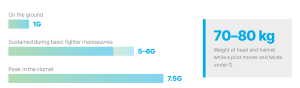
The physics explain why. During basic fighter manoeuvres a pilot sustains 5 to 6G for much of the sortie, peaking at 7.5G in the Hornet. Add a helmet-mounted display or night-vision goggles, and head and helmet can weigh 70 to 80 kilos while the pilot is moving and twisting. Operation Okra added duration to that load: missions of ten hours and more, flown with NVGs.
The same load exists outside the cockpit. Ground crew, loadmasters, technicians and infantry carry their own version — repeated loading of the spine, hips, knees and shoulders, every shift, for a whole career.
The surprise in the data
Here is where measurement changed the conversation.
The RAAF put its trainee aircrew on a conditioning programme — later named Fighter Fit — using the David Spine Concept, starting with a trial at 76 Squadron, RAAF Williamtown. Crews were tested on electronic, networked devices that measure range of motion, strength and endurance, and those results set risk categories and target areas.
The assumption going in was that fighter pilots have strong necks: they load them every day. The tests said otherwise.
“What we found was, in most tests we were above average in strength from the start. However, in neck rotation we were significantly weaker than the average population.” — Wing Commander Carlos Almenara, Executive Officer, 78 Wing, RAAF
A specific, trainable weakness, in exactly the movement nobody had been training, hidden behind generally good results. No amount of clinical experience would have found it. A measurement did, in an afternoon.
Why exercise programmes stay invisible
This is not an Australian problem, and it is not a problem of effort. It is a reporting problem that runs through the whole field.
Exercise therapy is an effective treatment option for the most common musculoskeletal pain conditions in primary care (Babatunde et al., PLOS ONE 2017). But a 2022 overview of systematic reviews in the British Journal of Sports Medicine asked a blunt question — if exercise is medicine, why don’t we know the dose? – and found that exercise interventions are reported so poorly, across conditions, that the dose actually delivered is unclear (Hansford et al.).
For a military health service, that translates into something uncomfortable. Physiotherapists work hard, service members train, budgets are spent — and at the end of the year nobody can show what the effort achieved per person, per unit or per year. A programme that cannot be shown to work is the first one cut.
What measurement changes in practice
Fighter Fit was built in three phases, and each one runs on the same data set.
Conditioning. Baseline tests set each crew member’s risk category and target areas, rather than putting everyone through the same programme.
Maintenance. Once crews move into the high-G phase, a monitoring app tracks pain, sleep, fatigue and soreness to catch problems early. The design choice matters: as the Williamtown physiotherapist Toby Watson explained, “The app was developed for us. It looks at specifics such as pain and well-being, but it’s not designed to ground aircrew.” Monitoring that threatens flying status gets under-reported. Monitoring that supports it gets used.
Rehabilitation. When it is needed, it starts from a documented baseline rather than a clinical guess.
The early results were reported as trends, not transformations: machine trials with lead aircrew in 2017 found promising improvement in strength in the targeted muscle areas after 12 weeks, split into two six-week blocks. On suspensions, Almenara’s account is specific and worth reading as the observation it is: “That was successful, and since we’ve done that, I haven’t seen a trainee suspended here for any physical-related problems.”
The programme was rolled out from Williamtown to RAAF Amberley, with similar programmes at Tindal and Pearce, and drew interest from the Canadian Armed Forces, the US Navy and the Royal Air Force.
The economics are already documented
Defence health leaders rarely get a budget for prevention on clinical logic alone. The civilian evidence base helps here, because the same devices and protocols have been measured at population scale.
In Germany, the FPZ back concept has been tested with more than 120,000 patients across more than 100 certified centres, and health insurers back the protocol. The published economics: 50.8% fewer sick days and 57.1% fewer doctor visits after a three-month programme (Schifferdecker-Hoch et al., 2014); a return on investment of 4.7 : 1 over four years for 24 sessions of the David Spine Concept (Daschner & Tschubar, Manuelle Medizin 2006); 16% lower direct medical costs two years after a 24-week programme (Müller et al., Journal of Rehabilitation Medicine 2019).
These are civilian populations, and results from one programme do not guarantee the same outcome in another setting. But the mechanism transfers directly, and so does the arithmetic: in a military context, a sick day is a day someone cannot deploy.
Where to start
Not with a service-wide rollout. With one group and one baseline.
Pick a population whose load you already worry about — one fast-jet squadron, one maintenance unit, one rehabilitation pathway. Test strength and mobility against norm values. Keep the measurements for twelve weeks of structured conditioning. Then look at what the data says about that group, rather than at what everyone assumes about it.
The RAAF’s finding was not that its pilots were unfit. It was that the one thing nobody had measured was the one thing that was failing.
Sources
- “Each year, the RAAF was losing 7 man-years of productivity, mainly due to neck problems”, originally published in Australian Aviation, September 2018 — davidhealth.com
- “How the Royal Australian Air Force conditions its fighter pilots effectively”, Australian Aviation, September 2018 — davidhealth.com
- Babatunde OO et al. Effective treatment options for musculoskeletal pain in primary care: a systematic overview of current evidence. PLOS ONE 2017.
- Hansford HJ et al. If exercise is medicine, why don’t we know the dose? British Journal of Sports Medicine 2022.
- Schifferdecker-Hoch F et al., 2014 (FPZ concept, three-month programme).
- Daschner W, Tschubar W. Manuelle Medizin 2006 (Gothaer Krankenversicherung; 24 sessions David Spine Concept, four-year follow-up).
- Müller et al. Journal of Rehabilitation Medicine 2019 (24-week programme, two-year follow-up).
- “German FPZ Concept offers back pain relief for hundreds of thousands” — davidhealth.com