English


What Is a Preoperative Care Pathway?
A preoperative care pathway is a structured physiotherapy program prior to surgery, designed to optimise a patient’s readiness for the surgical intervention. The main objectives are to:
- improve physical capacity and resilience
- reduce psychosocial risk factors such as fear and catastrophizing
- enhance self-management and lifestyle behaviour
- create realistic expectations regarding surgery and recovery
For spinal surgery patients, the pathway particularly targets individuals with:
- reduced strength or physical fitness
- fear of movement or pain catastrophizing
- low levels of physical activity
- suboptimal lifestyle factors (e.g. smoking, poor sleep, inactivity)
To achieve meaningful physiological adaptations, the program typically lasts a minimum of six weeks
Screening and Patient Selection
Not every patient automatically enters the preoperative pathway. Selection is based on a combination of validated questionnaires and physical assessments, such as:
- Pain Catastrophizing Scale (PCS)
- Tampa Scale of Kinesiophobia (TSK)
- Numeric Rating Scale (NRS)
- IPAQ-SF (physical activity level)
These tools help identify modifiable physical and psychosocial factors. Combined with objective physical testing, they allow clinicians to tailor the intervention and monitor progress over time.
Physical Training as the Core of Prehabilitation
A key component of the preoperative care pathway is improving:
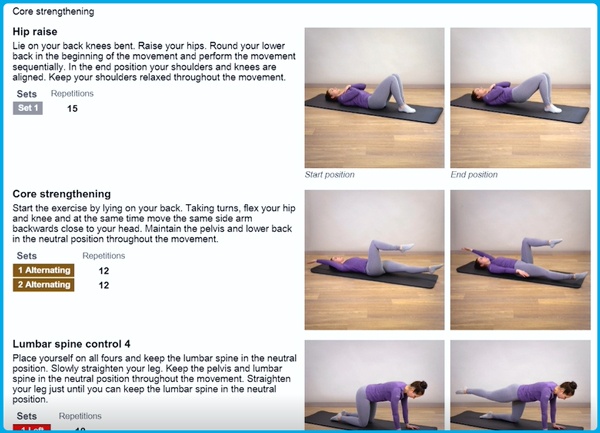
- muscular strength
- muscular endurance
- functional trunk stability
- cardiovascular capacity
Scientific evidence consistently shows that patients who enter surgery in better physical condition:
- mobilise earlier after surgery
- experience fewer postoperative complications
- have shorter hospital stays
- return more quickly to daily activities
This is where training with DAVID devices offers distinct advantages.
1. Biomechanically Guided and Safe Training
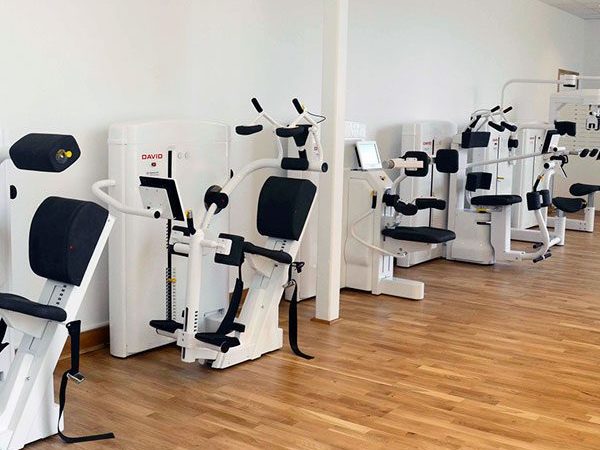
DAVID devices are designed to guide movement in a biomechanically correct and controlled manner. This is particularly important for spinal patients because it:
- minimises compensatory movements
- allows safe loading within pain limits
- reduces fear of movement
This makes DAVID devices especially suitable for patients with pain-related anxiety or uncertainty prior to surgery.
2. Objective Baseline Assessment and Progress Monitoring
The preoperative pathway relies on baseline measurements and re-evaluation. DAVID systems enable:
- objective measurement of strength and range of motion
- precise monitoring of progress over time
- individualised load progression
These objective data support clinical decision-making and align well with outcome-based care models.
3. Targeted Training of Trunk and Spine-Related Muscles
Preoperative training often focuses on:
- trunk stability
- spinal extension and rotation capacity
- hip and lower limb function
DAVID devices are specifically engineered for isolated and functional training of both deep and superficial trunk musculature, something that is difficult to achieve consistently with free exercises alone.
4. Standardisation Across the Care Pathway
One of the goals of a preoperative care pathway is consistency and quality of care, independent of therapist or location. Training with DAVID devices:
- enables standardized protocols
- reduces variability in treatment
- supports collaboration between the hospital and primary care
This fits seamlessly within a transmural care model, as promoted in modern spinal care networks.
5. Improved Motivation and Therapy Adherence
Because patients can clearly see and feel their progress, DAVID-based training often results in:
- increased confidence in movement
- greater engagement in the rehabilitation process
- higher adherence to the program
This directly supports behavioural change, a key pillar of successful prehabilitation.
Prehabilitation as an Investment in Recovery
A well-designed preoperative care pathway is not an additional burden—it is a strategic investment. By optimising patients before surgery:
- postoperative recovery improves
- healthcare utilization decreases
- patient satisfaction increases
DAVID devices provide clinicians with a safe, measurable, and evidence-based training solution to support this approach.
Conclusion
An effective preoperative care pathway requires:
- objective assessment
- safe and targeted training
- reproducible and standardised protocols
DAVID devices integrate seamlessly into this framework, supporting physiotherapists and care networks in applying the better in, better out principle in daily practice.
Scientific Evidence – Preoperative Care Pathways & Prehabilitation
Punnoose AM, Haines TP, Davidson S.
Prehabilitation for patients undergoing orthopedic surgery: A systematic review and meta-analysis. Journal of Orthopaedic & Sports Physical Therapy 2023;53(1):1–15.
Durrand J, Singh SJ, Danjoux G.
Prehabilitation before surgery: A systematic review. Clinical Medicine (London) 2019;19(6):458–466.
Marchand AA, Suitner M, O’Shaughnessy J, Châtillon CE, Cantin V, Descarreaux M.
Effects of an exercise-based prehabilitation program for patients awaiting lumbar spinal surgery. Spine 2015;40(17):E1031–E1039.
Marchand AA, Descarreaux M, Cantin V.
Prehabilitation prior to lumbar spine surgery: A systematic review. European Spine Journal 2019;28(10):2241–2254.
Fors M, Enthoven P, Abbott A, Öberg B.
Effects of pre-surgery physiotherapy on pain, function, and activity after lumbar spine surgery. BMC Musculoskeletal Disorders 2019;20:93.
Arguisuelas MD, Lisón JF, Sánchez-Zuriaga D, Martínez-Hurtado I, Doménech-Fernández J.
Effects of a prehabilitation programme based on therapeutic exercise, back care education, and pain neuroscience education in patients scheduled for lumbar surgery. Musculoskeletal Science and Practice 2024;68:102861.
Lotzke H, Jakobsson M, Brisby H, Gutke A, Hägg O, Smeets R.
Preoperative physical activity level predicts outcome after lumbar disc surgery. BMC Musculoskeletal Disorders 2016;17:447.
Jakobsson M, Hägg O, Olofsson K, Brisby H, Gutke A, Smeets R.
Prediction of activity limitation and participation restriction after lumbar spine surgery. Spine Journal 2019;19(9):1466–1476.
Rolving N, Nielsen CV, Christensen FB, Holm R, Bünger CE, Oestergaard LG. Preoperative cognitive-behavioral therapy improves functional outcomes after lumbar spinal fusion. Spine 2016;41(13):1084–1093.
Comer C, Redmond AC, Bird ML, Conaghan PG. Exercise treatments for lumbar spinal stenosis: A systematic review. Journal of Orthopaedic Research 2024;42(2):215–226.
Zaina F, Tomkins-Lane C, Carragee E, Negrini S. Surgical versus non-surgical treatment for lumbar spinal stenosis. European Spine Journal 2023;32(4):857–870.