English


A growing patient group
In 2020, around 595 million people worldwide lived with osteoarthritis. For the hip, the Global Burden of Disease study projects a rise of almost 79% by 2050, to over 62 million people [1].
What does the research say?
Exercise is first-line care. The Dutch guideline on conservative management of hip and knee OA (NOV, 2019) recommends supervised exercise therapy when education and self-management advice are not enough [2]. NICE (NG226, 2022) recommends offering everyone with osteoarthritis exercise tailored to their needs, such as local muscle strengthening and general aerobic fitness [3].
The effect is real, but modest. The Cochrane review by Fransen and colleagues pooled 10 RCTs with 549 participants. Exercise improved pain by 8 points and function by 7 points on a 100-point scale, with a number needed to treat of 6. The effect was sustained 3 to 6 months after treatment [4].
Dose makes the difference. Moseng and colleagues analysed 12 studies with 1,202 participants. Programmes with high compliance with ACSM dose recommendations produced a clear pain effect (SMD −0.42). Where the dose was uncertain, the effect almost disappeared (SMD 0.04) [5]. A recent meta-analysis of resistance training in hip and knee OA (28 RCTs) also found a dose-response relationship, though with low certainty of evidence [6].
Not every programme works. In the RCT by Bennell and colleagues (JAMA, 2014; n=102), a physiotherapy package of manual therapy, home exercise and advice was no better than sham treatment [7]. Read alongside Moseng, it is less a case against exercise than a reminder: what you prescribe and what the patient actually receives are two different things.
Training can postpone surgery. In the Norwegian RCT by Svege and colleagues (n=109), one group received twelve weeks of exercise plus education, the other education only. After six years, 41% of the exercise group still had their native hip, versus 25% of controls. Median time to total hip replacement was 5.4 versus 3.5 years (HR 0.56) [8].
Hip strength is measurable and trainable. People with hip OA often have reduced gluteal muscle size and lower hip strength. A systematic review found a small but significant gain in hip abduction strength from resistance training [9].
Large-scale programmes show the same picture. In the Danish GLA:D programme (8 weeks, 12 supervised sessions), hip pain among 2,492 participants fell from 47 to 36 mm on the VAS at three months, and the improvement held at one year [10]. Note: this is registry data, not an RCT.
Why the dose so often stays unknown
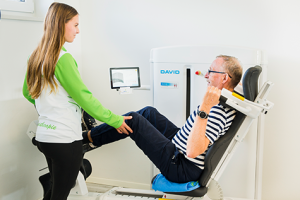
The problem is not the therapist’s knowledge. It is measurement. With free weights, bands or body weight, it is hard to say afterwards what load a patient really handled in week 3, how many repetitions were completed, or whether the hip abductors got stronger or only the compensation did. The record says “programme progressed”, not a number.
Without a number there is no data-driven progression, no evidence for referrer or payer, and no answer to the patient’s question: is this actually getting better?
What DAVID changes
The DAVID g-line Hip & Knee setup isolates the muscle groups that matter most in hip OA: hip extension (G260), hip abduction (G310), hip adduction (G320), supported by the leg press (G220) and knee extension and flexion (G200, G300).
- A baseline in numbers. Isometric strength tests and mobility tests per device record the starting point before the first training session.
- Dose per repetition. EVE software records load, range and repetitions automatically. “Did this patient receive an effective dose?” gets an answer instead of an estimate.
- Progress you can show. At the twelve-week review, you show a curve, to the patient and the referrer.
DAVID doesn’t create a new therapy. It makes the therapy the guidelines already recommend measurable, so you know the dose is right.
The equipment is classified as Medical Class 1m with measuring function.
References
- GBD 2021 Osteoarthritis Collaborators. Global, regional, and national burden of osteoarthritis, 1990–2020 and projections to 2050. Lancet Rheumatol. 2023;5(9):e508–e522. doi:10.1016/S2665-9913(23)00163-7
- Nederlandse Orthopaedische Vereniging (NOV). Richtlijn Conservatieve behandeling van artrose in heup of knie — module Oefentherapie. Richtlijnendatabase, 2019.
- NICE. Osteoarthritis in over 16s: diagnosis and management (NG226). 2022. Rec. 1.3.1.
- Fransen M, McConnell S, Hernandez-Molina G, Reichenbach S. Exercise for osteoarthritis of the hip. Cochrane Database Syst Rev. 2014;(4):CD007912. doi:10.1002/14651858.CD007912.pub2
- Moseng T, Dagfinrud H, Smedslund G, Østerås N. The importance of dose in land-based supervised exercise for people with hip osteoarthritis: a systematic review and meta-analysis. Osteoarthritis Cartilage. 2017;25(10):1563–1576. doi:10.1016/j.joca.2017.06.004
- Liu W, Yin M, Li H. Optimizing resistance training for pain management in knee and hip osteoarthritis: a pairwise and dose–response meta-analysis. Front Public Health. 2025;13:1623679. doi:10.3389/fpubh.2025.1623679
- Bennell KL, Egerton T, Martin J, et al. Effect of physical therapy on pain and function in patients with hip osteoarthritis: a randomized clinical trial. JAMA. 2014;311(19):1987–1997.
- Svege I, Nordsletten L, Fernandes L, Risberg MA. Exercise therapy may postpone total hip replacement surgery in patients with hip osteoarthritis: a long-term follow-up of a randomised trial. Ann Rheum Dis. 2015;74(1):164–169.
- Rostron ZPJ, Green RA, Kingsley M, Zacharias A. Efficacy of exercise-based rehabilitation programs for improving muscle function and size in people with hip osteoarthritis: a systematic review with meta-analysis. Biology. 2021;10(12):1251. doi:10.3390/biology10121251
- Skou ST, Roos EM. Good Life with osteoArthritis in Denmark (GLA:D): evidence-based education and supervised neuromuscular exercise delivered by certified physiotherapists nationwide. BMC Musculoskelet Disord. 2017;18:72. doi:10.1186/s12891-017-1439-y