English


Why Hip Extension is the Missing Link in Musculoskeletal Rehabilitation
When clinicians think about hip rehabilitation, the conversation often centres on leg press machines, hip abduction exercises, and general lower-body strengthening. But there’s a critical piece that has long been overlooked, targeted, controlled hip extension. DAVID Health’s G260 Hip Extension device is changing that, and for good reason.
The Glute Problem Nobody Talks About
The gluteus maximus is the largest muscle in the human body. It’s the powerhouse behind nearly every meaningful movement we make, such as walking, climbing stairs, rising from a chair, and stabilising the lower back and pelvis. Yet despite its importance, it remains one of the most undertrained and underrehabilitated muscles in clinical practice.
Why? Because training the glutes in isolation is genuinely difficult. The gluteal muscles are deeply connected to the pelvis, so when significant force is applied, as in most traditional strength exercises, the pelvis can tilt uncontrollably. That pelvic instability doesn’t just reduce the effectiveness of the exercise; it can put the lower back at real risk.
This is exactly the engineering challenge DAVID Health set out to solve.
Introducing the G260 Hip Extension
The DAVID G260 Hip Extension device is the newest addition to DAVID’s Hip & Knee Solution lineup and addresses the problem of glute training head-on. Rather than settling for a leg press (which doesn’t adequately target the gluteus maximus) or hip abduction (which misses it entirely), DAVID designed a dedicated device that isolates and safely loads the hip extensors.
The result is a medically certified exercise device classified as a CE Medical Device, Class 1M, that delivers precise, controlled hip extension for both rehabilitation and preventive care.
What Makes It Different?
Several thoughtful engineering choices set the G260 apart.
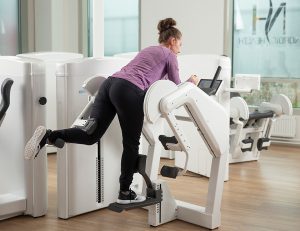
Pelvic stabilisation by design. The device places the user in a slightly rotated body position and provides lower leg support with an angled knee. This combination ensures maximum gluteal isolation and activation while preventing the harmful pelvic tilt that makes freestanding glute training risky for patients in pain or post-surgery.
Electronic footplate adjustment. Correct joint alignment is critical in rehabilitation settings. The G260’s electronically adjustable footplate height allows clinicians to dial in the exact positioning needed for each individual patient, regardless of height, limb length, or mobility limitations.
Self-adjusting movement arm cushions. The movement arm adapts to the user automatically, reducing setup time while ensuring consistent, comfortable contact across patient populations.
Unilateral capability. One leg at a time. This is essential for detecting and correcting strength imbalances between sides — a key goal in both post-operative rehabilitation and injury prevention.
Range of motion flexibility. With eight steps of range-of-motion adjustment, the G260 accommodates patients at all stages of recovery, from early post-op to full return to function.
Who Is It For?
The G260 is particularly well-suited for:
Hip replacement patients. Pre- and post-operative rehabilitation for total hip arthroplasty requires careful, progressive loading of the hip extensors. The G260 allows clinicians to apply that load safely and measurably from the earliest appropriate stages of recovery.
Hip osteoarthritis. Strengthening the muscles around a compromised joint reduces the mechanical load on the joint itself. Targeted gluteal strengthening can meaningfully reduce pain and improve function in patients with hip OA.
Lower back pain. Weak gluteal muscles are a well-documented contributor to chronic low back pain. Because the G260 trains the glutes in isolation — without loading the lumbar spine — it’s a safe option even for patients with concurrent back complaints.
Athletes and active individuals. Strength imbalances and gluteal inhibition are common precursors to injury in active populations. The G260’s unilateral training capability makes it a powerful tool for sports rehabilitation and injury prevention programs.
The Muscles Targeted
The primary targets of the G260 are the gluteus maximus and gluteus medius — the two muscles most responsible for hip extension power and pelvic stability. In a straight-leg position, the device also engages the hamstrings: the biceps femoris, semimembranosus, and semitendinosus. This makes it a remarkably comprehensive posterior-chain exercise without overloading any single structure.
Evidence-Based Rehabilitation, Not Guesswork
DAVID Health’s broader philosophy is grounded in the idea that rehabilitation outcomes improve when exercise is precise, measurable, and progressive. The G260 integrates with DAVID’s EVE software platform, which allows clinicians to track strength levels, range of motion, progression over time, and patient adherence — turning every session into objective data.
Isometric torque can be measured at four specific angles (60°, 30°, 0°, and -30°), giving practitioners a detailed picture of where in the range of motion a patient is strong or weak. That information shapes treatment decisions in ways that subjective observation simply cannot.
A Complete Hip Solution
The G260 completes DAVID’s Hip & Knee Solution by adding the one movement pattern that was previously missing: direct, isolated hip extension. Combined with DAVID’s leg press, hip abduction, and knee devices, clinicians now have a full toolkit for addressing virtually any hip or lower-extremity complaint with the precision that modern rehabilitation demands.
For clinics that pride themselves on outcomes, that’s not a small upgrade; it’s a fundamental one.
Interested in adding the G260 to your clinic? Contact sales and request a quote or watch a device demonstration.